

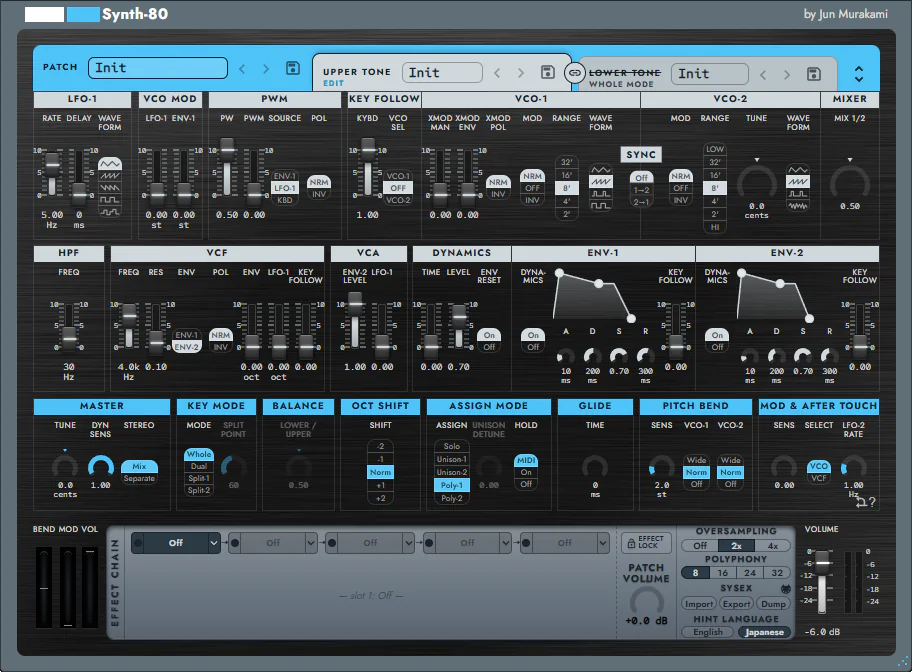
The world’s first※ full-fledged MKS-80 Rev.4 emulator
Authentic sound, meticulously analyzed
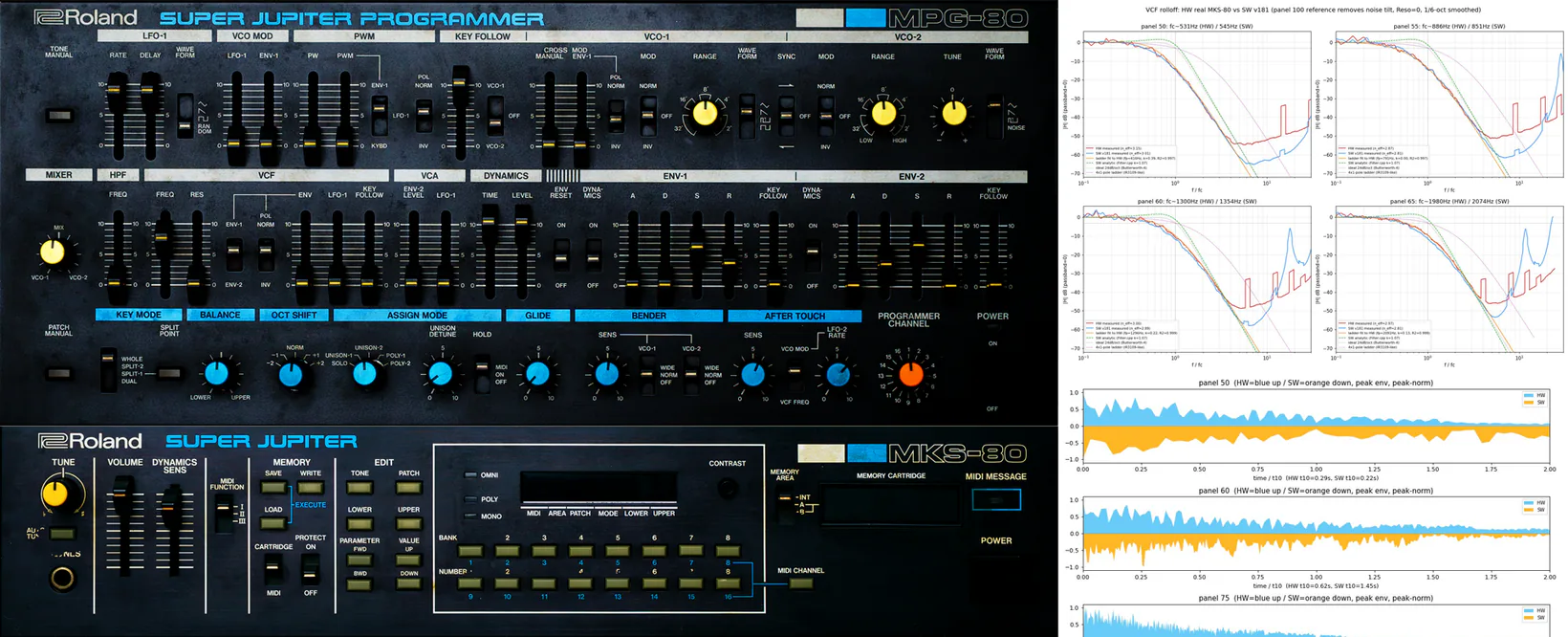
The Roland MKS-80 SUPER JUPITER is a legendary synthesizer produced only for a short period beginning in 1984. Often overshadowed by popular keyboards such as the JUPITER-8, this 8-voice polyphonic analog synthesizer is defined not only by its refined sound but also by a remarkable trait: almost every one of its parameters can be controlled over MIDI.
For a fully analog synthesizer of its era this was extraordinarily rare, and it makes the MKS-80 an ideal subject for software-synthesizer research — in other words, it is easy to build measurement programs that retrigger notes again and again while automatically sweeping the parameters, capturing detailed analyses. For this project I wrote more than 100 dedicated automated measurement programs covering every circuit and parameter of the MKS-80.
This long-term, detailed analysis of the MKS-80 (Rev.4) was carried out in parallel with the software programming itself, and I pushed the audio DSP tuning to the very limit, relying on the ears I have cultivated over many years as a composer and music producer. As a result, when you load exactly the same patch on both and play them side by side, for many patches it is virtually impossible to tell which is the software and which is the hardware.
From the delicate characteristics of the filters to the noise oscillators with subtle nuances derived from IC chips, the sound texture, recreated with meticulous attention to every detail, elevates the level of hardware emulation to a new height.
A simple, stripped-down user interface
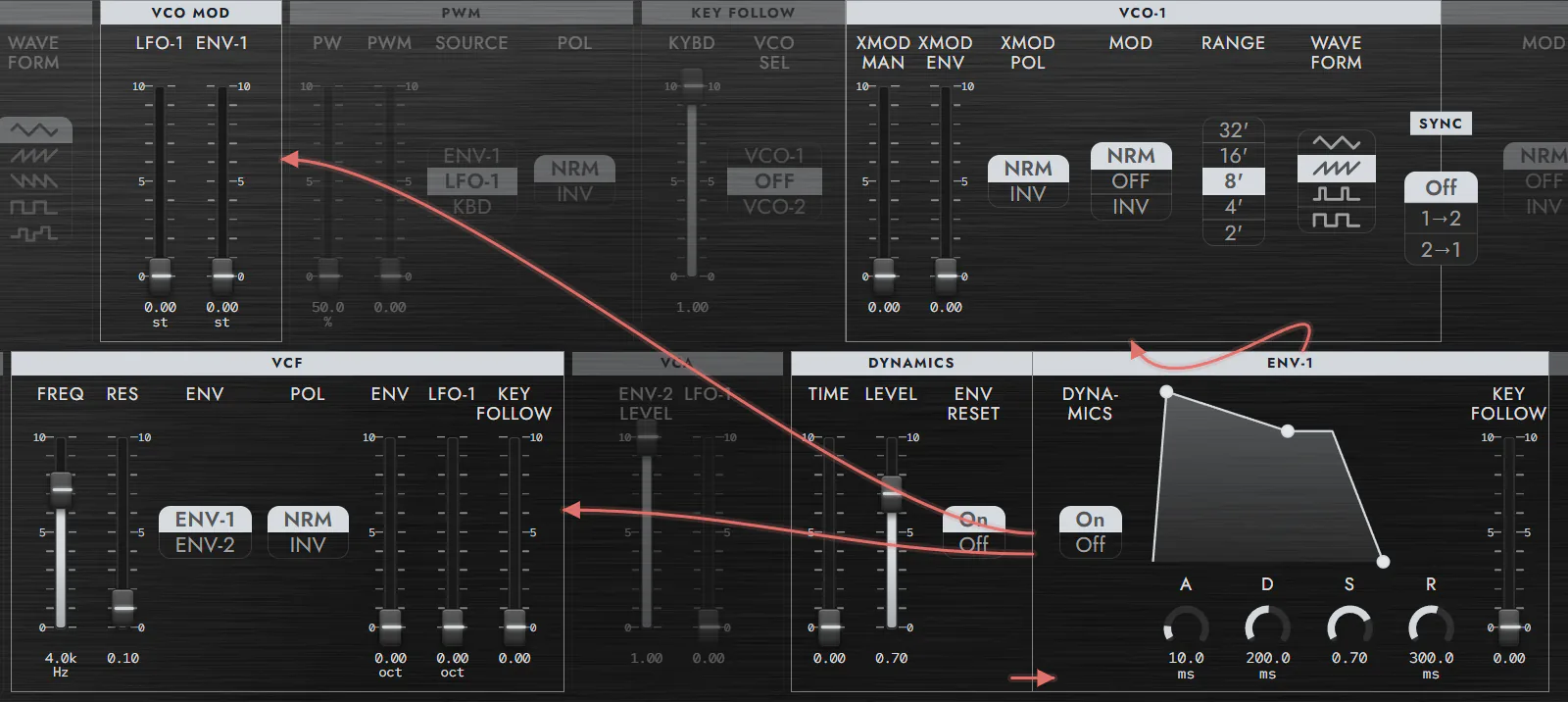
This synthesizer was developed with a different concept from the all-purpose software synths packed with extensive modulation matrices. Beyond merely reproducing the hardware, its single most important goal is to let you feel how easy and how enjoyable sound design can be — a goal realized in a simple user interface that strips away every unnecessary parameter and ornament and shows all parameters on a single screen.
This philosophy is influenced by Synth1 by Daichi, of whom I am a fan, and the straightforward naming follows Synth1’s lead. As a feature only software can offer to beginners, hovering the mouse over a parameter highlights the related module, so the signal wiring — which module connects to where — is clear at a glance.
High-quality effects, including four independent choruses
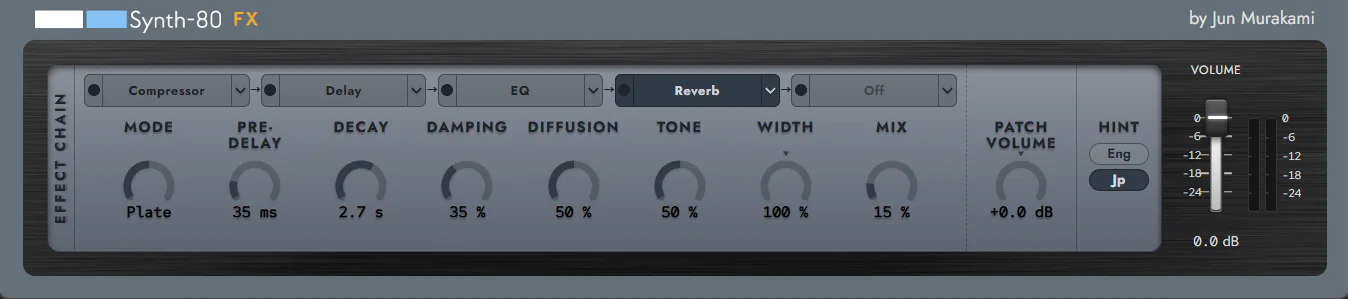
The built-in effects are crafted to a level where you would want to use them on their own — in fact, the Synth-80 effect rack can be split out and used as a standalone audio effect plugin. The chorus, especially important in synth sound design, comes in four completely different models:
- Synth ChorusAn emulation influenced by the built-in choruses of synths such as the Roland JUNO-60/106, with a strong character all its own — including a rotary-like sound when notes are held together.
- Studio ChorusAn emulation of the legendary rack-mount chorus, the Roland Dimension D. Its low-warble algorithm blends into any sound, giving a natural and refined sense of width.
- Pitch ChorusA chorus inspired by Eventide units, creating width with delay lines detuned to two slightly different pitches.
- Digital ChorusThe chorus with the most parameters, giving you fine control over a wide range of elements to dial in exactly the texture you want.
Beyond these, a reverb with completely different Hall, Plate, and Room algorithms, and a compressor that adopts the ZeroComp algorithm as-is, give your sound design powerful support.
Not a lightweight synth — but a heavyweight sound
Because of its complex modeling down to the finest details, this synth is — in exchange for its sound — by no means light on the CPU. Please do not judge it by the browser version on this page alone; be sure to install the demo into your own DAW and try it there. In return, we promise a sound worthy of that cost.
Download the demo
After purchase, you can use it as the full version immediately.
Version 1.0.23
Additional Patches by Sound Creators
High-quality additional patches created by experienced sound designers are available.
- Added September 25, 2026 - 143 Patches by David A. Logan (Bundled with Ver. 1.0.21)
- Added September 13, 2026 - 20 Patches by Björn Bojahr (Bundled with Ver. 1.0.18)
- Added July 29, 2026 - 70 Patches by Björn Bojahr (Bundled with Ver. 1.0.16)
- Added July 10, 2026 - 110 Patches by Takeshi Abo (valsound) (Bundled with Ver. 1.0.13)
- Added July 5, 2026 - 32 Patches by Saif Sameer (Bundled with Ver. 1.0.11)
Pricing
Specifications
- Included plugins
- Synth-80 Instrument, Synth-80 FX
- Editor & Librarian
- Full integration with a real MKS-80 (patch bulk-dump send/receive, bank builder, edit-parameter send/receive)* Due to the MIDI-output spec of the hardware, the MPG-80 cannot be used as an editor for this plugin.
- Licensing
- Online activation or Key file (offline activation on the authorized machine)
- Factory presets
- 530+
Recommended specs
Windows
- Windows 10 or later (64-bit)
- 4 GB RAM
- 4-core CPU, 3 GHz
- 100 MB free disk space
- ARM processors are not supported on Windows
Formats: Standalone / VST3 / AAX
VST2 and 32-bit are not supported.
Apple (Mac)
- macOS 11 or later
- 4 GB RAM
- 4-core CPU, 3 GHz or Apple M1
- 100 MB free disk space
Formats: Standalone / VST3 / AU / AAX
VST2 and 32-bit are not supported.

Developer: Jun Murakami (real name Jun Takahashi). He began his music career in 1999 as a composer for film and visual media, with credits including the TV anime “Steins;Gate” and the Otsuichi-based film “GOTH.”
Since 2011 he has been with MAGES. Inc., handling music production for numerous artists and IPs as a music director/producer and A&R (“Laid-Back Camp,” “Plastic Memories,” “B-PROJECT,” “Eri Sasaki,” “cadode,” “Konomi Suzuki,” and more).
Since 2025 he has worked as a freelancer. In recent years he has focused on programming, also providing DX support for audio production companies and music labels.
※ “World’s first” is based on the developer’s own research.